
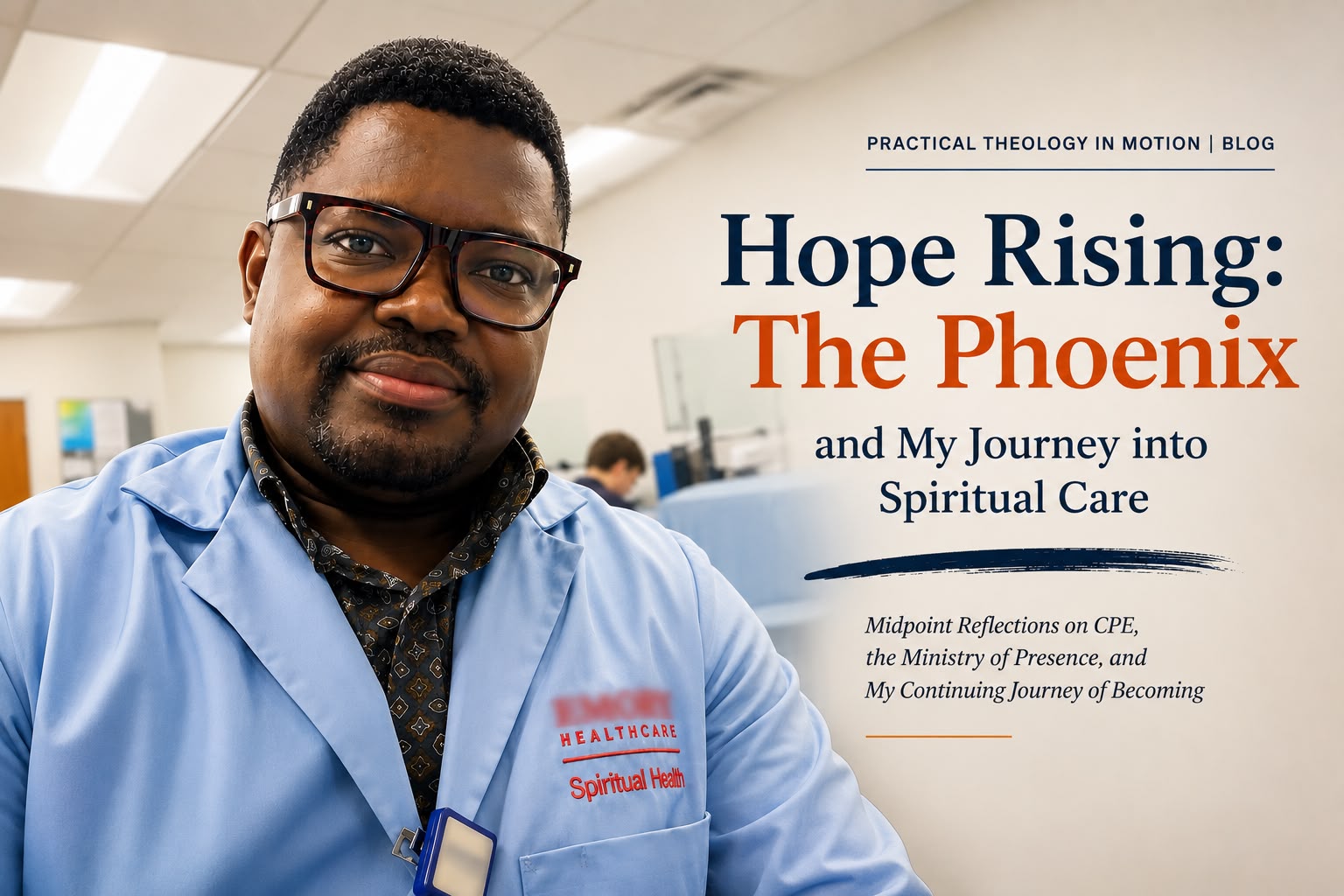
Midpoint Reflections on CPE, the Ministry of Presence, and My Continuing Journey of Becoming
The journey of becoming continues.
When I began Practical Theology in Motion in 2025, I chose the Phoenix as a metaphor for my theological journey. For me, the Phoenix represents renewal, resilience, transformation, and the possibility of beginning again. Practical theology should not remain only in books, classrooms, or behind the pulpit. It must enter the realities of everyday life.
This summer, theology entered the hospital with me.
On June 1, 2026, I began a summer Clinical Pastoral Education program. I entered with years of teaching, research, ministry, and academic experience. I am accustomed to speaking, explaining, and sometimes providing answers. Yet, within the first few weeks, I realized that CPE was teaching me another language of ministry: the language of presence. (PTIM)
Now, at the midpoint of the program, I find myself returning to the image of the Phoenix—not only as a symbol of rising from ashes, but also as an image of hope that remains present even when renewal is not yet visible.
Where Hope Begins
The hospital has given new meaning to the image of Pheonix and ashes.
A person can begin the day with plans and, within hours, find life changed by sickness, diagnosis, pain, or loss. Independence can disappear. Families may move quickly from expecting recovery to discussing end-of-life care. Questions that once seemed distant suddenly become immediate.
In these moments, I am learning the limits of what I can do.
I cannot heal every patient. I cannot remove every pain or promise that everything will be fine. I cannot force anyone to rise from the ashes.
But I can enter the space.
I can sit with a patient, listen to a story, and remain present when there are no easy answers. I can pray when prayer is desired and respect silence when words are unnecessary. I am discovering that hope does not always begin with a solution. Sometimes, it begins when a person realizes that they do not have to face their suffering alone.
This is changing my understanding of ministry. I once thought that being helpful often meant having something meaningful to say. CPE is teaching me that sometimes the most meaningful thing I can do is listen.
Martha Jacobs describes the chaplain’s task as helping people “refind their theology and tap into it to sustain them through this crisis” (Jacobs, 2012). That captures what I am discovering in CPE. I do not enter a patient’s room to give them my theology; I enter to discover what gives that person meaning, strength, hope, and connection. Plummer (2012) reminds caregivers that this work also requires a clear personal theology grounded in integrity, grace, and respect for all people. Together, these reflections have helped me see that spiritual care is both deeply personal and deeply relational. I remain rooted in my Christian faith while making room for the patient’s story, beliefs, and hopes to guide the encounter. This balance is becoming an important part of my own theology of spiritual care.
I do not enter the hospital as an empty person. I enter as a Nigerian, an African, a Christian, a minister, a teacher, a researcher, and a student of Practical Theology. My history and beliefs enter the room with me.
CPE is helping me see how easily my background can shape my expectations.
I remember meeting a patient in pain who told me clearly that he did not believe in God. His response surprised me. Somewhere within my Nigerian and Christian formation was an assumption that suffering might make a person more open to God or supernatural help.
That encounter exposed my assumption.
I have also spent time with a Jewish patient and had one of my most meaningful encounters with a nonreligious couple. These experiences are widening my understanding of spiritual care. I am learning to meet the person who is actually before me rather than the person I expected to meet.
Suffering does not produce the same response in everyone. One person may turn toward God. Another may become angry with God. Someone else may question everything. Another person may have no interest in religious language at all.
My responsibility is to listen before I interpret.
This is cultural humility in practice.
Recognizing Hope in Unexpected Places
My understanding of the sacred is also changing.
I still believe deeply in God, Scripture, and prayer. My Christian identity remains central to who I am. Yet spiritual care is teaching me that sacred moments are not always announced with religious language.
The sacred may emerge in the story of a long marriage. It may be present in a photograph beside the bed, a patient’s tears, a memory of home, or the name of a child spoken with love. Sometimes, it is found in silence.
Hope can also appear in unexpected places. It may not always mean physical healing or a return to the life a person had before illness. Hope may mean reconciliation, peace, forgiveness, acceptance, courage, or the comfort of being surrounded by family. For another person, hope may simply mean making it through one more day.
I am also learning that not every encounter must end with spoken prayer. Sometimes the conversation itself becomes prayer. A patient has spoken, cried, remembered, and been heard. Nothing more needs to be added.
For someone trained to speak, this is a significant lesson.
Presence has its own language.
Hope at the Edge of Life
The terms ‘end-of-life care’ or ‘hospice’ are common in the hospital, but I have started thinking more deeply about what those words mean.
As a Christian, I do not understand physical death as the absolute end of life. My faith gives me hope beyond death. Yet I meet patients whose beliefs about death are different from mine. Some believe in eternal life. Others understand what comes after death through different religious traditions. Some are uncertain, while others believe death is simply the end.
As a spiritual health clinician, I cannot impose my answer on their journey.
I need to ask what death means to the person before me. What do they hope for? What are they afraid of? Is there unfinished business, guilt, peace, or uncertainty?
Even when medicine can no longer prevent death, spiritual care still has a place. I can journey with the patient in what they believe, fear, hope for, or simply do not know.
This is where the Phoenix becomes especially important to me. The Phoenix speaks of life, death, transformation, and renewal. Yet I am learning not to rush anyone toward resurrection language or a happy ending. The patient must be allowed to name their own hope.
Sometimes, I may not see the Phoenix rise.
Sometimes, my ministry is simply to remain beside the ashes, trusting that presence itself can carry hope.
The Phoenix Is Also Me
When I first chose the Phoenix for my Practical Theology in Motion journey, I thought mainly about theological transformation. Now, I see myself in the image more clearly.
CPE is changing me.
I am learning to slow down, observe my reactions, and become more comfortable with silence. I am learning that good intentions do not replace self-awareness. I can remain grounded in my Christian faith while making room for another person’s beliefs and experiences.
I am not losing the Christian minister, teacher or scholar, I have been. I am becoming more aware of how I use these parts of myself in caring for others.
The hospital has become another classroom, but the learning here is different. Patients are not theological case studies. They are people who allow me, sometimes for only a few minutes, to enter deeply personal moments of their lives. Their stories are teaching me about suffering, dignity, doubt, faith, death, presence, and hope. (PTIM)
At this midpoint in my summer CPE journey, I know that I still have much to learn.
The programme is not finished.
Neither am I.
The Phoenix remains my image because hope is not always loud or immediately visible. Sometimes, hope rises through healing. Sometimes, it rises through acceptance, reconciliation, memory, or peace. At other times, hope is simply the courage to remain present in a difficult moment.
Spiritual care, for me, is the willingness to enter the ashes of human experience, listen for what is sacred to the person before me, and journey with them through uncertainty, life, and death.
I may not solve the problem.
I may not see the Phoenix rise.
But I can be there.
And sometimes, hope begins to rise because someone stayed. This is my Phoenix. This is my journey of becoming. This is practical theology in motion.
To see the visual reflection behind this journey, watch the video on YouTube: Watch “Hope Rising: The Phoenix and My Journey into Spiritual Care”
Jacobs, M. R. (2012). Creating a personal theology to do spiritual/pastoral care. In S. B. Roberts (Ed.), Professional spiritual & pastoral care: A practical clergy and chaplain’s handbook (pp. 1–11). Skylight Paths Publishing.
Plummer, D. B. (2012). Creating a personal theology to do spiritual/pastoral care. In S. B. Roberts (Ed.), Professional spiritual & pastoral care: A practical clergy and chaplain’s handbook (pp. 12–17). Skylight Paths Publishing.
Note
This reflection grew out of my mid-unit review and Theology of Spiritual Care presentation during my Clinical Pastoral Education journey.
Written by Ayodele John Alonge, July 13, 2027 @MRC
M.A. in Practical Theology (MAPT) Candidate
Columbia Theological Seminary, Decatur, Georgia

This is a very interesting and fascinating write-up. It raises awareness about several important issues.
Our environment, level of exposure, and personal experiences significantly shape our perceptions and influence the way we see and respond to situations.
Self-awareness goes a long way in providing compassionate, patient-centered care. It is essential to recognize our own beliefs, values, cultural backgrounds, and religious perspectives while ensuring they do not interfere with the care we provide. By separating our personal views from our professional responsibilities, we can respect each patient’s unique beliefs, preferences, and values, ultimately fostering trust, empathy, and better healthcare outcomes.
Being in an advanced and highly developed healthcare system does not always guarantee a cure or a positive outcome for every illness or medical condition.
Despite remarkable advances in medicine and technology, some diseases remain incurable, and not every patient will recover. This reality highlights the importance of providing compassionate, holistic care that prioritizes comfort, dignity, and emotional support alongside medical treatment.
There are situations where silence as you have mentioned,active listening, respect, maintaining eye contact, and offering a simple, reassuring touch can be more meaningful than words .These compassionate gestures can provide comfort, convey empathy, and promote healing for patients during difficult moments.
Prayer can also be a powerful source of healing and encouragement when the individual is ready and receptive to it.
There are also situations where you have to compassionately communicate the reality of a patient’s condition with honesty, empathy, and sensitivity is often the most appropriate and respectful approach.
Thank you for sharing your thoughtful perspective.