
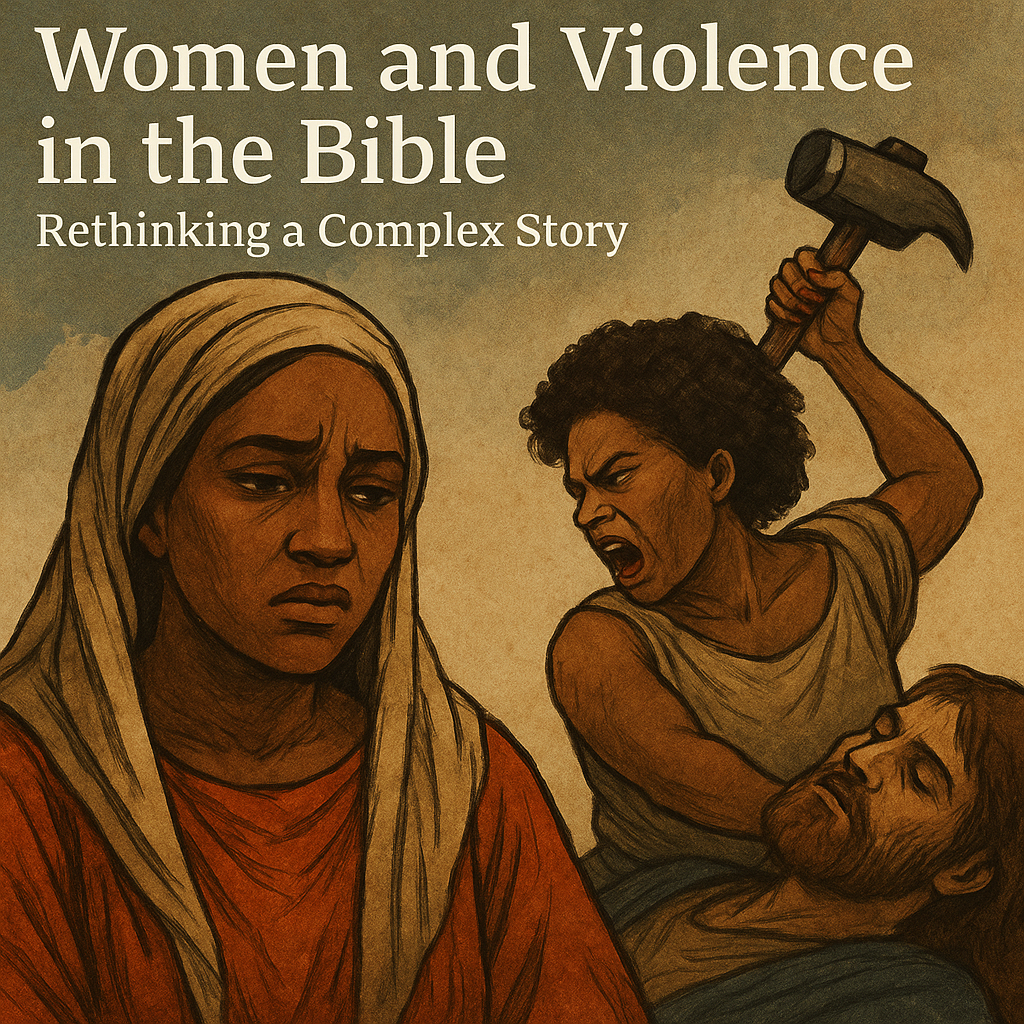
Are women always victims in Scripture? Are men always the violent ones? The Book of Judges challenges our easy assumptions. This reflection explores how biblical stories complicate our modern stereotypes—and why our practical theology must tell the whole truth about violence if healing is to begin.
During a recent class session on the Book of Judges at Columbia Theological Seminary, I attempted to offer a balanced perspectives of the violent narratives within the text. My core argument was simple but unsettling to some:
violence is not the exclusive reality of any single gender.
I began by stating, “The Bible shows that not only men are violent; women also can be violent.”
This comment drew visible discomfort and strong objection. Yet the reaction itself revealed how deeply gender stereotypes shape our reading of Scripture—and our understanding of human suffering.
To move forward faithfully, we must read Scripture with honesty, humility, and emotional maturity.
Gender-Based Violence: A Painful Reality Across Communities
Gender-based violence is a lived reality across societies, including African and diaspora communities. It destroys families, fractures relationships, and undermines the dignity of God’s image in humanity.
While women and girls are disproportionately victims of domestic, sexual, and structural violence, it is also true that men can be victims, and women can sometimes act as perpetrators.
A truthful, compassionate theology must make space for every victim and every perpetrator, because violence is violence—wherever it originates.
Women in Scripture: Courage, Complication, and the Capacity for Violence
Scripture does not flatten women into one-dimensional characters. It portrays them with agency—sometimes nurturing, sometimes courageous, and sometimes capable of harm.
Jael (Judges 4–5): Deliverer or Betrayer?
Jael welcomes Sisera, a fleeing commander, into her tent—a place associated with safety.
Yet she kills him with decisive brutality.
“Most blessed of women be Jael… She struck Sisera, she crushed his head.”
— Judges 5:24, 26
Her act brings deliverance, yet remains morally unsettling. It is intimate, shocking, and violent.
The story resists simple categories.
Delilah (Judges 16): Violence Through Strategy, Not Strength
Delilah is often reduced to a villainous stereotype. But the text shows her exercising:
-
strategy
-
emotional intelligence
-
persuasion
-
relational power
Her harm is psychological rather than physical, but it is harm nonetheless. She is not passive in Samson’s downfall—she acts intentionally and with agency.
Violence Is Not Gendered — It Is Human
One lecturer summarized this reality well:
“Women also can be violent. Men are also violent. Violence is violence; it is not good at all.”
This is not an attempt to erase the gendered patterns of violence—nor to deny that women face greater systemic vulnerability. Rather, it keeps us from slipping into shallow moral binaries.
Violence grows from:
-
human brokenness
-
fear and survival
-
trauma and retaliation
-
unjust structures
-
misuse of power
Men and women alike carry these vulnerabilities. Men and women alike can cause harm.
And men and women alike can participate in healing.
Implications for Practical Theology
A grounded Practical Theology must tell the truth—not selectively, but fully. It must speak honestly about violence, regardless of who commits it. It must recognize every victim, including those whose stories are silenced by shame, patriarchy, or cultural disbelief.
Such a theology must also affirm women’s full humanity: not only as nurturers or sufferers, but also as thinkers, strategists, leaders, and, in some cases, participants in violence. Healing begins when we resist stereotypes that flatten human experience, and instead confront the real complexities of harm and restoration within our communities.
Conclusion: Healing Beyond Stereotypes
The Book of Judges does not give us flawless heroes. Instead, it presents a society unraveling under moral confusion and escalating violence.
Within this broken landscape, women appear as:
-
Deliverers — Deborah and Jael
-
Strategists — Delilah
-
Victims — the Levite’s concubine
To build a more compassionate world, we must confront violence in all its expressions.
- Not to shame, but to heal.
- Not to accuse, but to transform.
- Not to divide, but to restore dignity to every person made in the image of God.
Reflection Prompts for Readers
-
Where have gender stereotypes prevented us from recognizing real suffering?
-
How might churches and theological institutions better support every victim of violence?
-
What does it mean to interpret Scripture in ways that honor women’s full humanity—strengths, flaws, complexity, and all?
Ayodele John Alonge
Tuesday Nov 30, 2025, 11:10pm (EST)
Marcia Riggs Commons (MRC),
701 S Columbia Decatur, Atlanta Georgia